

Originally published in the Daily Bulletin on April 24, part of the Inspiring Vibrant Health Column.
Jessica Flores treasures every moment with her 9-month-old son, Jaziel. Whether she’s on the floor for playtime or in the kitchen preparing meals, Flores is determined to give her son the best start possible, including providing for him financially.
But returning to work has proved nearly impossible for the Upland resident, due to a lack of consistent, affordable childcare. She is now facing the prospect of returning to work in May without a plan for Jaziel’s care.
“Up until this point, I’ve relied on family and my neighbor to watch Jaziel for a few hours here and there,” Flores said. “I want to go back to work, but I can’t find any affordable full-time care that doesn’t have a long wait list.”
Flores is one of 30,000 families in the region on waitlists for subsidized childcare. She explored daycare centers without waitlists, but the price tag — $1,200 per month — is out of reach.
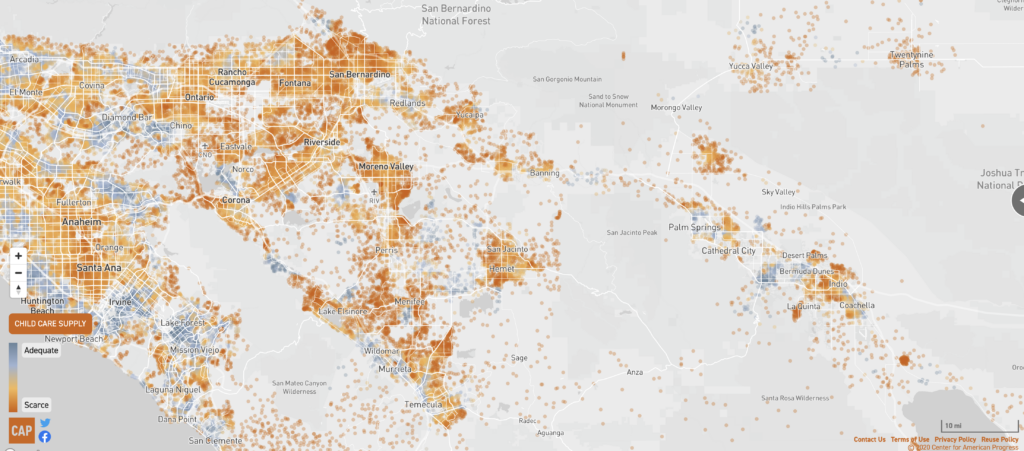
Families across the country are struggling to find and afford care for their young children, and more providers closing their doors are fueling the rise of childcare deserts. The data highlights a stark reality for both parents and early childhood care providers.
Childcare deserts are areas where limited childcare slots are not accessible or affordable for the average parent. Nationally, 51% of Americans live in childcare deserts; however, in California, more than 60% of residents live in childcare deserts.
Care for infants, 0-12 months, is even more scarce. A survey conducted by the Public Policy Institute of California reported that only 31% of families could find affordable infant care, compared to 77% for preschoolers.
Programs exist to help families offset the costs, including federal funding support and state subsidies. However, the California Budget and Policy Center found that only 8% of eligible children in Riverside and San Bernardino counties were enrolled in state-funded care in 2022.
Mirroring state and national trends, the Child Care Resource Center, which supports families and providers in Southern California, providing subsidized childcare and resources for low-income families, has seen a sharp decline in the number of licensed providers in the Inland Empire due to a myriad of reasons, including rising costs, labor shortage and burdensome operating requirements.
James Moses, director of strategic engagement, Inland Empire Region at the Child Care Resource Center, describes this as a perfect storm that will further reduce affordable, licensed childcare options.
“We are seeing declining birthrates, 4-year-olds moving to transitional kindergarten, providers and teachers leaving the profession for better-paying jobs or closing of centers and family childcare homes altogether,” Moses said. “We are starting to see a lot more dark (empty) classrooms.”
Families face long waitlists, limited choices, and soaring costs, especially for infants, toddlers, and those needing care outside regular hours. Many are forced to cobble together temporary solutions, change work schedules or exit the workforce entirely.
The Bureau of Labor Statistics reported that 455,000 women nationwide left the workforce between January and August 2025, with caregiving responsibilities and childcare costs cited as the top reasons, according to Catalyst.org.
In California, momentum has grown in recent years to support working parents and struggling childcare providers. State policies supported by childcare advocates have aimed to address the crisis by easing licensing barriers for teachers and expanding classroom capacity for infants and toddlers.
Gov. Gavin Newsom has also championed universal preschool that recently expanded transitional kindergarten for all 4-year-olds in California, allowing more children to enter the public school system before age five.
As a result, more families have enrolled 4-year-olds in public schools rather than in local subsidized or private daycare centers. While universal preschool has helped many families access free education, the shift has led to the closure of private and at-home childcare centers — leaving many families with younger children with fewer childcare options.
Organizations like the Child Care Resource Center and other nonprofits in Riverside and San Bernardino counties are working to address workforce shortages and advocate for improved policies and solutions for both families and early childhood providers.
The Inland Empire Community Collaborative leads the IE Children’s Cabinet, a two-county initiative supporting children, youth and families while advancing health and racial equity across the region through policy and advocacy.
Brian Romo, Inland Empire Community Collaborative’s director of public policy and technology, said the nonprofit has held community listening sessions with families across the two counties and childcare is a top concern at nearly every meeting.
“Many parents have told us that even if they could find childcare, many facilities do not accommodate non-traditional working hours or drop-in hours for part-time workers,” Romo said. “One parent shared it was more financially reasonable to quit her job and take care of her kids herself because every dollar she earned was going to pay for childcare.”
Providers Need Care, a member of the Children’s Cabinet, offers childcare teachers and providers training, business counseling, compliance assistance, and personal care services to strengthen their businesses and better serve children in Riverside and San Bernardino counties.
CEO Yvonne Choyce says the childcare crisis is closely linked to a shrinking workforce. Low wages, burnout, and rising costs are driving providers out of the field, while fewer people are entering it.
“To truly address childcare deserts, we must invest in the people behind the care, supporting provider sustainability, wellbeing, and workforce development so that access can expand for families across our region,” Choyce said.
Child Care Resource Center’s San Bernardino regional office is addressing workforce shortages by offering apprenticeships in partnership with local community colleges designed to inspire and support the next generation of childcare providers.
While the challenges are steep, advocates say coordinated efforts offer hope. For parents and providers alike, the goal remains: that one day, finding childcare in the Inland Empire will be a manageable step toward a healthy, stable future for every family.