Have you ever opened the paper, scrolled through social media or turned on the news and found yourself searching for something uplifting? Stories about hope, resilience and personal growth can resonate deeply. While it’s important to stay informed about the challenges in our world, we also crave moments that remind us what’s possible when people come together and overcome obstacles.
Here in the Inland Empire, those reminders are all around us. Individuals and organizations demonstrate daily that meaningful change is happening right here, close to home.
Yet many of those same organizations face increasing communication challenges: competing for attention in a crowded media landscape, making the case for funding in shifting philanthropic climates and advocating for policy change in a polarized era. Even though storytelling is one of their greatest potential tools, it may not be their greatest strength.
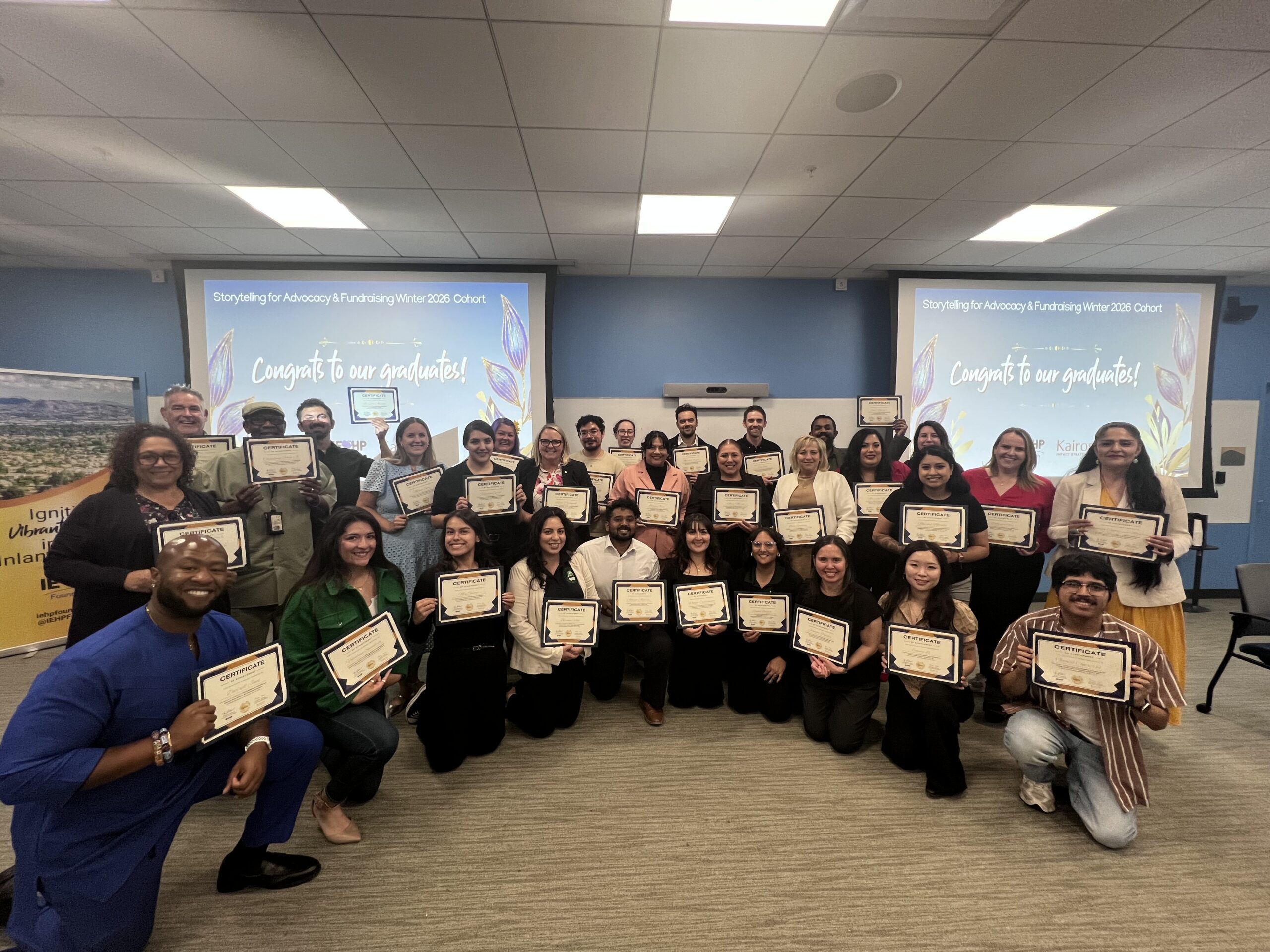
To address this need, IEHP Foundation launched the Storytelling for Advocacy & Fundraising Training Cohort in early 2026. The eight-class program provided 35 leaders from 20 Inland Empire organizations with tools and support to strengthen storytelling for fundraising and advocacy. Each organization received a $1,500 grant upon completion to initiate a storytelling project.
IEHP Foundation partnered with Kristen Caloca, CEO of Kairos Impact Strategies, to lead the series. The group focused on communication techniques such as ethical and trauma-informed storytelling, as well as methods for identifying impactful and inspiring narratives.
“It was such a joy to watch these leaders connect with each other as they learn side by side because it’s in that shared space that insight deepens, confidence grows, and real trust takes root,” Caloca said.
Most participants were already familiar with communication concepts, narrative framing, and story development but sought to further strengthen their skills. The results were clear: nearly every storytelling skill area increased by 50 percentage points.
During the program, each organization developed stories demonstrating the impact of their work in the Inland Empire, designed to help inspire more donations, attract new volunteers and change policy.
For California Family Life Center, Roger was a memorable child they met during his placement in foster care — a 15-year-old boy in need of safety, stability and hope. Through California Family Life Center’s Resource Family Foster and Adoption program, Roger found a secure and nurturing home.
During the holidays, California Family Life Center youth look forward to the Giving Tree, a community-driven campaign that ensures every child receives donated gifts. When a California Family Life Center social worker sat with Roger and his resource parent to create his Christmas wish list, Roger didn’t hold back. This was his moment. He carefully wrote down each item he’d always wanted — from wrestling shoes to a baseball hat and even boxing gloves.
The group distributed thousands of Angel cards across Southern California, and one of those cards — Roger’s — caught the attention of a local motorcycle club. Moved by his list, they decided to go all in. That Christmas, for the first time in his life, Roger received every gift he wished for.
That act of kindness changed more than just his holiday — it changed his life. Today, Roger is a successful small business owner. And every year, he comes back to support the Giving Tree program, completing a full circle of generosity and continuing the legacy of hope that once lifted him.
Symba Center, a healthcare clinic and housing nonprofit based in Victorville, recalled one of their clients, Paul, who faced a long, difficult road after years of living on the streets. At first, connection was difficult. His conversations were hard to follow, and his “unusual” behaviors could have easily been overlooked. But the Symba Center team realized he was trying, in his own way, to communicate.
Instead of correcting him, the team looked for strengths beneath his behavior. They saw care, effort, and a desire to contribute. One day, they asked, “Paul, would you help us wash the windows?” He paused; unsure the question was meant for him. “You want me to do that?”
Something shifted. For the first time in a long time, Paul wasn’t just receiving help — he was being given new purpose. He was not being defined by what was wrong. He was being recognized for what still remained: his ability, his dignity, his desire to be part of something.
Paul began taking better care of himself. His room was cleaner. He started engaging more with others on campus and participating in supportive services — no longer out of compliance, but because trust made space for healing. His story reminds us that homelessness is not only the absence of housing, but often the loss of routine, identity, belonging and purpose.
In San Bernardino, a group of concerned mothers recognized that without a safe outdoor space for their children, they would need to create one themselves.
Through working with El Sol Neighborhood Education Center, this group envisioned a space designed not only to address community challenges but to uplift its potential.
“We heard from community leaders and promotores who walk alongside their neighbors every single day,” said El Sol Executive Director Alex Farjado. “These are individuals who, despite systemic barriers, continue to push forward.”
That vision became the El Sol Park & Learning Center now under construction. This is more than a park, it is a response, a solution and a promise to the community. The community-driven space will create a safe space to connect outdoors.
The storytelling cohort produced results even before training concluded. After the very first class, Beth Spalding, advancement officer at Children’s Fund, recognized the value of beginning with her organization’s “why.” She applied the approach days later during an employee-giving campaign presentation.
“I adjusted my usual pitch and started with our why and tied in impact stories, connecting to Children’s Fund’s top three priorities. The audience was visibly touched and signed up 70 employees during the campaign launch,” she said.
She credits the storytelling training with strengthening her call to action. “Because I started with the reason why Children’s Fund exists, my call to action was stronger; it really ramped up the giving we got right then.”
Months after the training, Riverside Medical Clinic Charitable Foundation continues to use the new skills and narrative frameworks to enhance their communications. Rather than simply announcing open applications for their 2026 Healthcare Scholarship Program, the team connected the foundation’s purpose to the region’s need for healthcare professionals and to students preparing to serve the community. This approach influenced website messaging and outreach to colleges and universities, emphasizing the urgency and impact of investing in future healthcare workers.
The results exceeded expectations: five times as many applications as the previous cycle, and students from additional colleges and universities across Riverside and San Bernardino counties. Riverside Medical Clinic Charitable Foundation also secured new funding that supported an additional scholarship opportunity.
“One of our most important lessons was that storytelling does not have to be reserved for demonstrating impact after a program has concluded. It can also inspire people to participate, share an opportunity, or invest in its success,” Riverside Medical Clinic Charitable Foundation Executive Director Krystel Joseph said.
These stories and the leaders behind them demonstrate what becomes possible when organizations strengthen their ability to communicate hope, impact and possibility. And they remind us that uplifting stories aren’t rare. They’re happening every day across our region, ready to be told.