
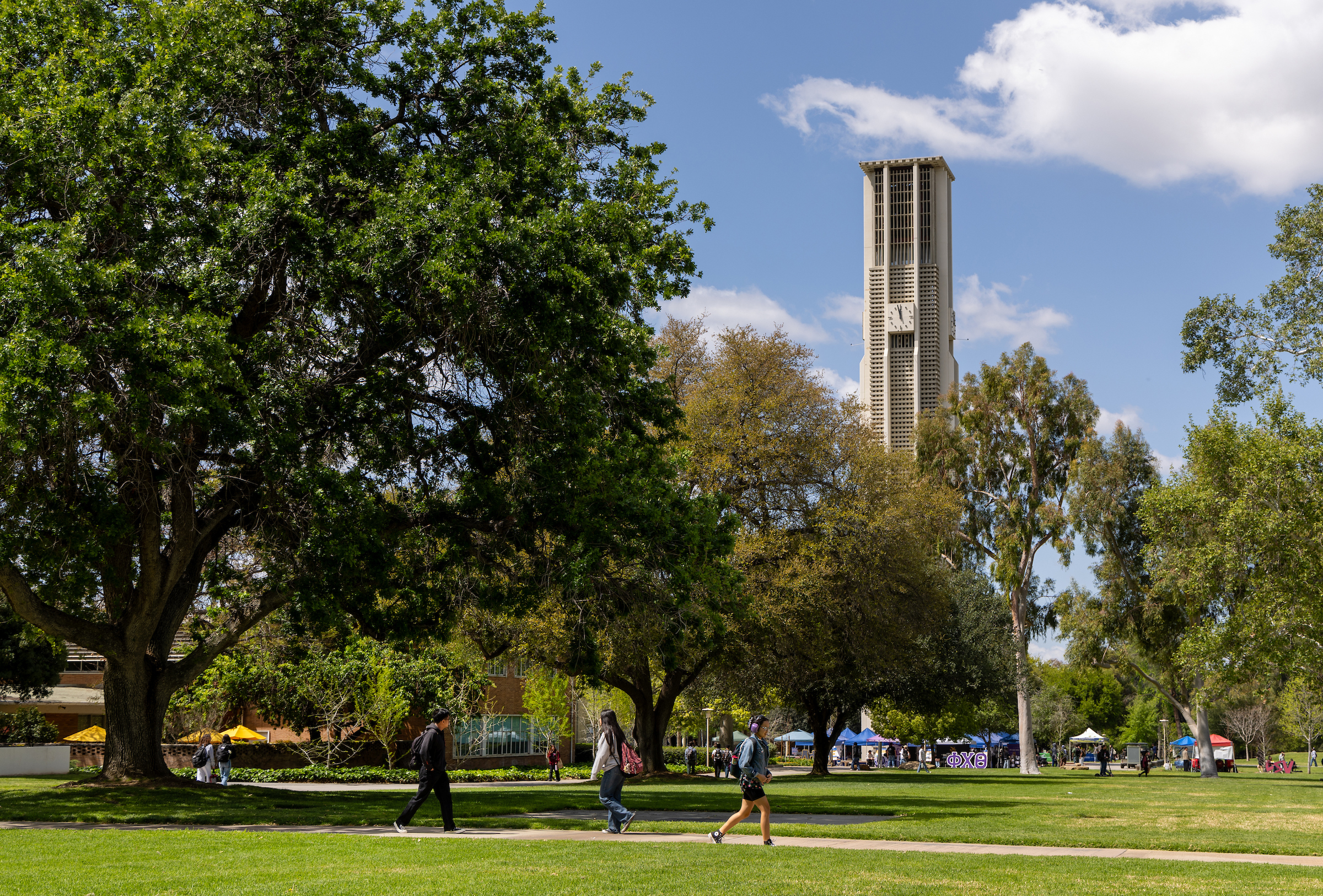
Did you know UC Riverside holds the distinction of being named the top university for social mobility by U.S. News & World Report? Not only is it currently No. 1 in the nation, but it has also been ranked at the top of the list for five of the past seven years.
So, what does that actually mean? It means UC Riverside boosts students’ economic standing more than other colleges across the nation. U.S. News & World Report defines social mobility as a university’s ability to enroll, retain and graduate large proportions of economically disadvantaged students. In other words, it ranks schools that successfully advance students from low-income backgrounds into higher earning, improved socioeconomic positions.
The university was also ranked No. 1 in the country by the Chronical for Higher Education for retention of first-year students who have Pell grants – typically from families earning less than $50,000 a year.
According to the university, it is not only good professors and a strong academic environment that produce these results. It is also the location of the school within the opportunity-rich Inland Empire.
“UC Riverside is not simply located in a region of opportunity — it is an engine of opportunity,” said Chancellor S. Jack Hu. “We enroll talented students with extraordinary potential, regardless of their socioeconomic background, and provide a top-tier education alongside support systems designed to help them graduate. It is this interdependence of excellence and access that distinguishes UC Riverside from universities across the country and helps our students rise from one economic level to the next.”
Beyond the borders of the UC Riverside campus, there are many facets of the region that make the Inland Empire fertile ground for those aspiring to climb the economic ladder and build a solid financial tomorrow. But there is also room for growth as we work to build a future that allows all families to thrive economically.
Let’s start with the cost of living in the Inland Empire. Granted, we live in Southern California, which is known to be 30-40% more expensive than the national average. But for those of us who have lived outside of California, it’s a bit easier to understand the “sunshine tax” when enjoying a clear, sunny 80 degree day in March.
When comparing to the rest of Southern California, however, the Inland Empire is significantly more affordable in a number of respects. According to the California Association of Realtors, as of early 2026 the median home cost was $500,990 in San Bernardino County and $639,440 in Riverside County compared to $879,720 in Los Angeles County and $1,410,000 in Orange County. Similarly, rents in the Inland Empire are also about 30% lower than our coastal neighbors.
Examining broader affordability in the region, according to United Ways of California’s Real Cost Measure, $98,572 is required to support a household of two adults, one preschooler and one school-aged child in the Inland Empire. By comparison, an estimated $120,624 is needed to support that same family living in the Greater Los Angeles region.
Clearly, earning six figures to support a family of four anywhere requires both good jobs and good educational opportunities to prepare a skilled workforce. Fortunately, with over 30 colleges, universities and technical schools located in the Inland Empire, opportunities and career pathways for students are vast.
Growing Inland Achievement is a local nonprofit organization that works collaboratively with educational partners across the region to achieve the bold goal of 70% of working-age adults to possess a postsecondary degree or credential. In partnership with 56 local school districts, GIA works to bolster K-12 outcomes, including early literacy and middle school math, to ensure every student is ready for graduation and college or career training.
Ashish Vaidya, president and CEO for GIA, noted that both Cal State San Bernardino and UC Riverside are among the state’s leaders on the College Futures Foundation’s California Mobility Index but also points to the need to continue developing an equitable and effective post-secondary education ecosystem.
“The Inland Empire’s public higher-ed system is a powerful but uneven engine of economic mobility,” said Vaidya. “The Inland Empire has the ingredients for strong economic and social mobility, but we must scale the highest-value programs and strengthen transfer and completion pathways so that opportunity isn’t determined by which campus a student happens to start at.”
As the state’s second most populous Metropolitan Statistical Area, or MSA, and the nation’s 12th largest MSA, the Inland Empire has substantial population to drive our local economy. Although the region outpaced many state and national growth rates in post-pandemic job recovery, a handful of significant industries offer the majority of jobs, including one of the largest logistics hubs in the nation.
“According to Dr. Manfred Keil, chief economist for Inland Empire Economic Partnership, our job creating sectors are Healthcare, Public Education and Goods Movement,” said Paul Granillo, CEO for Inland Empire Economic Partnership. “Because of the continued growth of the region and importance of logistics to the nation’s economy, those three sectors will continue to offer upward economic mobility.”
Other notable sectors providing a considerable share of jobs across the region include retail trade, hospitality, health care, government and professional services — all of which will continue to grow as the region’s population continues to expand.
The Inland Empire offers young people opportunities for a great education, landing a stable job to support a household and a family-friendly community surrounded by beautiful mountains, valleys, lakes and deserts. But there is work to be done to ensure that this is a reality for all residents.
Together, with continued investment and collective action by our education, health, nonprofit and business sectors, we can strive for the entire Inland Empire region to be No. 1 in the country for social mobility.